El imprint se convirtió en arquitectura

Imagen: Cipher Horus Publ1sh1ng

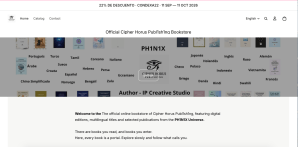
Hace 14 meses, cuando Cipher Horus Publ1sh1ng® comenzó a recorrer esta línea de tiempo con una coordenada muy clara — proteger y dar estructura a los materiales que surgieran desde Becoming Agile — no teníamos idea de lo que nos esperaba en el camino.

Lo que comenzó como un imprint editorial terminó convirtiéndose en algo mucho más grande.

Hoy, Cipher Horus Publ1sh1ng® funciona como un Author–IP Creative Studio independiente: el núcleo estructural detrás del ecosistema PH1N1X®, su arquitectura de propiedad intelectual, sistemas editoriales, universos narrativos y frameworks interdisciplinarios.

Becoming Agile® sigue siendo una rama fundamental dentro del ecosistema, especialmente en temas de productividad consciente, metodologías ágiles y modelos organizacionales centrados en lo humano.

Y hoy, Cipher Horus es la infraestructura conectiva entre todas las verticales:
publicaciones, frameworks, sistemas narrativos, arquitecturas translinguales, modelos educativos y desarrollo de propiedad intelectual de largo alcance.

Lo más interesante es que esta evolución nunca fue diseñada como una estrategia de expansión.

Ha ido emergiendo día con día, naturalmente, a través de la creación, la coherencia y el crecimiento sostenido del ecosistema.

En apenas 14 meses, el proyecto pasó de ser una extensión editorial a convertirse en un universo interconectado de libros, metodologías, arquitecturas de traducción, sistemas simbólicos y propiedad intelectual original operando en múltiples dominios e idiomas.

Cipher Horus Publ1sh1ng® ya no es simplemente el lugar donde las obras se publican.

Es el lugar donde el universo se está estructurando en tiempo real.

Y hoy, el imprint se ha convertido en la arquitectura que lo sostiene todo.

Cipher Horus Publ1sh1ng · Author – IP Creative Studio

PH1N1X · 0rigin T1mel1ne W3aver

9 de junio 2026


The imprint became the architecture

Image: Cipher Horus Publ1sh1ng

Fourteen months ago, when Cipher Horus Publ1sh1ng® began traveling this timeline with a very clear coordinate — to protect and give structure to the materials emerging from Becoming Agile — we had no idea what was waiting for us along the way.

What began as a publishing imprint eventually became something much larger.

Today, Cipher Horus Publ1sh1ng® operates as an independent Author–IP Creative Studio: the structural core behind the PH1N1X® ecosystem, its intellectual property architecture, editorial systems, narrative universes, and interdisciplinary frameworks.

Becoming Agile® remains a fundamental branch within the ecosystem, especially in the areas of conscious productivity, agile methodologies, and human-centered organizational models.

And today, Cipher Horus functions as the connective infrastructure across all verticals:
publications, frameworks, narrative systems, translingual architectures, educational models, and long-range intellectual property development.

What is most interesting is that this evolution was never designed as an expansion strategy.

It has been emerging day by day, naturally, through creation, coherence, and the sustained growth of the ecosystem.

In just 14 months, the project evolved from a publishing extension into an interconnected universe of books, methodologies, translation architectures, symbolic systems, and original intellectual property operating across multiple domains and languages.

Cipher Horus Publ1sh1ng® is no longer simply the place where works are published.

It is the place where the universe is being structured in real time.

And today, the imprint has become the architecture that sustains it all.

Cipher Horus Publ1sh1ng · Author – IP Creative Studio

PH1N1X · 0rigin T1mel1ne W3aver

June 9, 2026

¿Estás a tu favor… o en tu contra?

No necesitas que nada ni nadie te valide.
Necesitas validarte tú.

Elegirte cada día es eso.
Elegir lo que quieres hacer.
Elegir lo que crees.
Elegir lo que te gusta.

Y, sobre todo, elegir y abrazar el potencial que ves en tu futuro, incluso cuando nadie más lo ve.
Porque cada vez que eliges tu camino, te eliges a ti.

Tu valor no depende de likes, de un salario mensual, de followers o de comentarios.
Eso es reconocimiento externo.

Pero tú…
¿te reconoces?

¿Sabes quién eres debajo de cada título, diplomado, curso o rol profesional?
¿Quién eres cuando no hay aplausos, métricas ni etiquetas?

Tu valor depende de ti.
De lo que piensas, de lo que sientes, de lo que dices y de lo que haces.
En armonía.
Con congruencia.
Alineado contigo.

El respaldo más importante que necesitas es el tuyo.
Creer en ti.
Confiar en ti.
Ser paciente contigo.
Reconocer tus logros y tus aprendizajes.
Cuidarte física, mental y emocionalmente.

Y cuando no lo haces, te estás traicionando.
Porque la única persona con la que cuentas de forma incondicional, 24x7x365,
eres tú.

Así que la pregunta es sencilla.
Hoy.
Donde estás.
Con lo que estás haciendo…

¿Estás jugando a tu favor… o en tu contra?

PH1N1X


Are you on your side… or against yourself?

You don’t need anything or anyone to validate you.
You need to validate yourself.

Choosing yourself every day is exactly that.
Choosing what you want to do.
Choosing what you believe.
Choosing what you like.

And above all, choosing and embracing the potential you see in your future, even when no one else can see it.
Because every time you choose your path, you choose yourself.

Your value does not depend on likes, a monthly salary, followers, or comments.
That is external recognition.

But you…
do you recognize yourself?

Do you know who you are beneath every title, certification, course, or professional role?
Who are you when there is no applause, no metrics, no labels?

Your value depends on you.
On what you think, what you feel, what you say, and what you do.
In harmony.
With coherence.
Aligned with yourself.

The most important support you need is your own.
Believing in yourself.
Trusting yourself.
Being patient with yourself.
Recognizing your achievements and your learnings.
Taking care of yourself physically, mentally, and emotionally.

And when you don’t, you are betraying yourself.
Because the only person you can count on unconditionally, 24x7x365,
is you.

So the question is simple.
Today.
Where you are.
With what you are doing…

Are you playing in your favor… or against yourself?

PH1N1X

Reconocer el apoyo: el verdadero punto de partida

Imagen: Pixabay

El apoyo tiene muchas formas de hacerse presente.
No siempre llega como aplausos, likes o grandes gestos visibles.
A veces llega como tiempo.
O como paciencia.
O como alguien que sostiene mientras tú avanzas.

En los equipos —y en la vida— el problema no suele ser la falta de apoyo.
Suele ser la incapacidad de reconocerlo.

El pensamiento humano promedio, en modo automático, opera como rueda de hámster:
Solo ve lo que falta.
No hay suficiente dinero.
No hay oportunidades.
No hay trabajo.
No hay tiempo.

Desde ahí, todo se vive como carencia… incluso cuando hay colaboración constante alrededor.

No se ve el apoyo de la pareja que sostiene económicamente mientras el otro redefine su camino.
No se ve el apoyo del compañero que cubre una tarea para que alguien más pueda ir a una entrevista.
No se ve el apoyo de quien cuida, gestiona, espera o confía.

Y sin embargo, ese sí es el trabajo en equipo.

Reconocer el apoyo no es un gesto emocional.
Es una habilidad operativa.

Cuando reconoces el apoyo:

  • dejas de sentirte solo,
  • tomas mejores decisiones,
  • avanzas con menos fricción,
  • y puedes evaluar con claridad si continuar, ajustar o cambiar el rumbo.

Vivimos en un mundo de colaboración permanente, aunque no siempre consciente.
La tecnología nos apoya.
La infraestructura nos apoya.
Las personas nos apoyan, incluso sin discursos épicos.

Pero hay un punto clave que casi nadie mira:

Así como otros ven lo mejor de ti y te apoyan desde ahí,
también es tu responsabilidad reconocerte y apoyarte a ti mismo.

La agilidad real no empieza cuando haces más.
Empieza cuando ves con claridad lo que ya está sosteniéndote.

Y desde ahí… decides mejor.

PH1N1X


Recognizing support: the true starting point

Image: Pixabay

Support takes many forms.

It doesn’t always come as applause, likes, or grand, visible gestures.

Sometimes it comes as time.

Or as patience.

Or as someone who holds your back while you move forward.

In teams—and in life—the problem isn’t usually a lack of support.
It’s usually the inability to recognize it.

The average person, on autopilot, operates like a hamster wheel: It only sees what’s missing.
Not enough money.
No opportunities.
No work.
No time.

From that perspective, everything is experienced as lacking… even when there’s constant collaboration around.

You don’t see the support of the partner who provides financial support while the other redefines their path.
You don’t see the support of the colleague who covers a task so someone else can go to an interview.
You don’t see the support of the person who cares, manages, waits, or trusts.

And yet, that is what teamwork truly is.

Recognizing support isn’t an emotional gesture.

It’s an operational skill.

When you recognize support:

you stop feeling alone,

you make better decisions,

you move forward with less friction,

and you can clearly assess whether to continue, adjust, or change course.

We live in a world of constant, though not always conscious, collaboration.

Technology supports us.
Infrastructure supports us.
People support us, even without grand pronouncements.

But there’s a key point that almost no one considers:

Just as others see the best in you and support you from that place,
it’s also your responsibility to recognize and support yourself.

True agility doesn’t begin when you do more.

It begins when you clearly see what’s already supporting you.

And from there… you make better decisions.

PH1N1X

Mirando al 2026

Imagen: Pixabay

Estamos llegando al cierre de este 2025 y con él aparece el ritual conocido: promesas, propósitos, listas de cambios que suenan bien… pero que -por las razones que sean- rara vez se sostienen.

Creo firmemente que el verdadero cambio no vive en las declaraciones.
Vive en la consistencia de los actos.

La coherencia no nace de los picos emocionales.
Nace del ritmo.

Moverse un paso a la vez.
Un día a la vez.
Una tarea a la vez.

No importa que «no se note» lo que está pasando.
Eso no es moverse lento.
Es llevar un ritmo sostenible.

Es el tipo de movimiento que garantiza algo que casi nadie menciona cuando habla de cambio:
Avance real,
Congruencia interna
y una satisfacción que no depende de la motivación del momento, sino de la alineación constante entre lo que piensas, lo que dices y lo que haces.

Ahí empieza todo.

Así que hoy que estamos a unas horas de que el calendario cambie y el 2026 entre con todo su esplendor, creo que vale la pena que te preguntes:
Esos propósitos que tienes en mente,
Esas metas…
¿por qué son importantes para ti?
La respuesta te dará el combustible que necesitas cada día para moverte paso a paso hacia esa línea de tiempo.

No la emoción del momento.
No la impulsividad de las acciones que después se transforma en arrepentimiento.
Tu coherencia y tu constancia son esos puntos de apoyo que estás buscando.

Feliz cierre del 2025 y que sea un espléndido 2026.

PH1N1X


Looking toward 2026

Image: Pixabay

We are reaching the close of 2025, and with it comes the familiar ritual: promises, resolutions, lists of changes that sound good… but that—for one reason or another—rarely last.

I firmly believe that real change does not live in declarations.
It lives in the consistency of our actions.

Coherence is not born from emotional peaks.
It is born from rhythm.

Moving one step at a time.
One day at a time.
One task at a time.

It doesn’t matter if what’s happening “isn’t visible” yet.
That’s not moving slowly.
That’s moving at a sustainable pace.

It’s the kind of movement that guarantees something almost no one mentions when talking about change:
real progress,
internal congruence,
and a sense of satisfaction that doesn’t depend on momentary motivation, but on the constant alignment between what you think, what you say, and what you do.

That’s where everything begins.

So today, as we are just hours away from the calendar turning and 2026 stepping in with all its splendor, it’s worth asking yourself:
those intentions you have in mind,
those goals…
why are they important to you?

The answer will give you the fuel you need each day to move, step by step, toward that timeline.

Not the emotion of the moment.
Not the impulsiveness of actions that later turn into regret.
Your coherence and your consistency are the points of support you’ve been looking for.

Happy closing of 2025, and may 2026 be truly splendid.

PH1N1X

No todo depende de que tú puedas más.

Imagen: Pixabay

Hay momentos en los que creemos que,
si las cosas no mejoran,
es porque nos falta aguantar o «hacer» un poco más.

Ser más fuertes.
Más positiv@s.
Más alinead@s.
Más resilientes.

Pero hay una verdad incómoda y liberadora:

No todo depende de que tú puedas más.

A veces ya estás haciendo muchísimo:

Sosteniéndote sin romperte

Manteniendo la calma en medio del temporal

Cuidando tu energía para poder seguir creando

Eligiendo no colapsar

Hablando con honestidad para construir equipo

Avanzando, aunque el entorno esté denso

Eso ya es trabajo.
Eso ya es liderazgo.
Eso ya es agilidad con alma.

La agilidad no es exprimirte.
Es adaptarte sin perderte.

No siempre se trata de hacer más.
A veces se trata de dejar de cargar lo que no te corresponde
para poder seguir avanzando con claridad.

Porque sostenerte
también cuenta.

Y mucho.

PH1N1X


Image: Pixabay

Not everything depends on you being able to do more

There are moments when we believe that
if things aren’t improving,
it’s because we’re not pushing ourselves enough.

Being stronger.
More positive.
More aligned.
More resilient.

But there is an uncomfortable — and liberating — truth:

Not everything depends on you being able to do more.

Sometimes, you are already doing so much:

Holding yourself together without breaking

Staying calm in the middle of the storm

Protecting your energy so you can keep creating

Choosing not to collapse

Speaking honestly to build real teamwork

Moving forward, even when the environment feels heavy

That is work.
That is leadership.
That is agility with soul.

Agility is not about squeezing yourself dry.
It’s about adapting without losing yourself.

It’s not always about doing more.
Sometimes it’s about stopping carrying
what was never yours to hold
so you can keep moving forward with clarity.

Because sustaining yourself
also counts.

And a lot.

PH1N1X

Carta abierta a los recién egresad@s 2025

Imagen: Pixabay

Esta semana pensé en mis años como docente y sonreí: es temporada de graduaciones.
Cientos de estudiantes, de diferentes edades, carreras y ritmos universitarios, están concluyendo una etapa que marca para siempre. Y sí, inevitablemente recordé a mis exalumnos… y también a quienes están cruzando esta puerta hoy.

Por eso, esta carta es para ti, recién egresad@ de 2025.

La mejor respuesta que puedes recibir al empezar tu camino es un “NO”.

Sé que históricamente esta palabra se asocia con rechazo, puertas cerradas o lugares donde “no te valoraron”.
Pero cuando miras tu vida en retrospectiva, descubres otra verdad:
un NO es un regalo envuelto de forma inesperada.

En absoluto es una pared.
Tampoco es un fracaso.
Y mucho menos es un juicio sobre tu valor.

Es una señal de desviación.
Como esas flechas en las calles donde hay obras: no te detienen, solo te indican que sigas por otro camino para llegar a donde vas.

Y aquí está lo esencial:

Cuando inicias un camino profesional, lo más importante es tener claro tu destino.
La ruta, claro que importa… pero importa porque el camino también es parte del destino.
Es ahí donde aprenderás, crecerás, cambiarás y —sobre todo— te encontrarás contigo mism@.

Así que cuando llegue un “NO”, presta atención.
A veces redirige a una ruta más larga.
A veces abre una inesperadamente corta.
Pero siempre, siempre multiplica oportunidades que no habrías visto de otra forma.

Como recién egresad@, tu reto es aprender a distinguir:

el NO profesional

del NO personal

Y recordar quién eres mientras avanzas con seguridad.

En mi experiencia, cada NO me ha llevado a algo infinitamente mejor: clientes más alineados, proyectos más significativos, escenarios más grandes y/o a las personas correctas para mi camino. He aprendido a agradecer esos NO porque me confirman que existe una dirección más adecuada esperándome.

Ahora te toca a ti.

Estás por entrar a un 2026 lleno de sueños, ambición y energía.
Tal vez el lugar donde querías trabajar te diga que no…
O tal vez una agencia, un país o una persona lo hagan.

Pero recuerda:

Un NO a un sueño es solo la apertura a una versión más grande de ese mismo sueño.

Nada es permanente.
Todo es temporal.
Somos energía en movimiento —y eso no se detiene.

Ustedes no son “el futuro”.
Ustedes son el presente que está moldeando el mundo ahora.

Les deseo un camino lleno de claridad, enfoque y valentía.
Que disfruten cada paso hacia el destino que eligieron… y que lo hagan conscientes del impacto que están generando.

PH1N1X
Becoming Agile


Open Letter to the Class of 2025

Image: Pixabay

This week I thought about my years as a teacher, and I couldn’t help but smile: it’s graduation season.
Hundreds of students —across ages, degrees, and university rhythms— are closing a chapter that will mark them forever. And yes, I inevitably remembered my former students… and also those of you crossing this doorway today.

So this letter is for you, graduate of 2025.

The best answer you can receive as you begin your path is a “NO.”

Historically, this word has been associated with rejection, closed doors, or places where “you weren’t valued.”
But when you look back at your life, you discover another truth:
a NO is a gift wrapped in an unexpected way.

It is not a wall.
It is not a failure.
And it is certainly not a verdict on your worth.

It is a signal for redirection.
Like the signs on streets under construction —they don’t stop you; they simply guide you toward a different road that still leads you where you’re meant to go.

And here is what truly matters:

When you begin your professional journey, the most important thing is to be clear about your destination.
The route, of course, matters… but it matters because the journey itself is part of the destination.
It’s where you’ll learn, grow, evolve, and —above all— meet yourself.

So when a “NO” appears, pay attention.
Sometimes it redirects you to a longer path.
Sometimes it opens an unexpectedly short one.
But always, always, it multiplies possibilities you wouldn’t have noticed otherwise.

As a new graduate, your challenge is to learn to distinguish:

  • the professional NO
  • from the personal NO

And to remember who you are as you move forward with confidence.

In my experience, every NO has led me to something infinitely better: more aligned clients, more meaningful projects, bigger stages, and the right people for my path.
I’ve learned to be grateful for those NOs because they confirm that a more fitting direction is waiting for me.

Now it’s your turn.

You’re stepping into a 2026 filled with dreams, ambition, and energy.
Maybe the place you wanted to work will say no…
Or maybe an agency, a country, or a person will do it instead.

But remember:

A NO to a dream is simply the opening toward a larger version of that same dream.

Nothing is permanent.
Everything is temporary.
We are energy in motion —and that cannot be stopped.

You are not “the future.”
You are the present that is shaping the world right now.

I wish you a journey filled with clarity, focus, and courage.
May you enjoy every step toward the destination you’ve chosen —and may you remain aware of the impact your steps are creating.

PH1N1X
Becoming Agile

“A mí no me interesa lo que hagan los demás… me importa lo que haces tú.”

– Tu mamá tenía razón –

Imagen: Pixabay

Crecimos escuchando esa frase como regaño, pero en realidad era una brújula.
Una verdad incómoda —y tremendamente liberadora— que la vida te repite una y otra vez cuando te distraes mirando hacia afuera.

Y hoy, me parece que recordar esa frase, es más necesario que nunca, porque:

La comparación es un atajo a la parálisis.
La imitación es un pasaporte a perderte.
La crítica constante solo habla del vacío de quien la emite.

Creo sinceramente que todos estamos aquí para ser, no para competir por quién grita más fuerte ni para ajustar nuestra identidad según el ruido del resto.

La pregunta real nunca ha sido:
“¿Qué están haciendo los demás?”
Sino:
“¿Qué estoy haciendo yo?”

Y a partir de esa respuesta, elegir, construir, aportar y diseñar un camino que no es ni bueno ni malo, simplemente es el tuyo y eso, es más que suficiente.

Tu mamá no te estaba regañando.
Te estaba recordando tu poder.

PH1N1X

Del control a la confianza: cómo la visibilidad sana la ansiedad organizacional

Imagen: Pixabay

Una de las raíces más profundas del micromanagement no es la desconfianza ni el ego (aunque pueden manifestarse así), sino la falta de visibilidad.
Cuando alguien no tiene acceso a la información que necesita para tomar decisiones o rendir cuentas, su mente entra en modo “control”.
Y desde ahí, comienza el ciclo del agotamiento.

La mente necesita saber

En cualquier sistema —humano o corporativo—, la incertidumbre genera tensión.
Si no sabes en qué está tu equipo, qué se está moviendo o cómo va el avance de un proyecto clave, tu sistema nervioso entra en alerta.
Empiezas a llenar vacíos con suposiciones: “¿Estarán avanzando?” “¿Y si no llegamos a la fecha?” “¿Por qué nadie dice nada?”

Desde esa tensión, muchas personas se vuelven controladoras sin darse cuenta.
Piden más reportes, más juntas, más actualizaciones.
Pero en el fondo, lo que están pidiendo es tranquilidad.
Lo que necesitan no es controlar más, sino ver mejor.

La visibilidad no es vigilancia

Uno de los errores más comunes es confundir visibilidad con control.
La visibilidad no se trata de “supervisar cada paso”, sino de hacer visible el flujo de trabajo, los acuerdos y los resultados para que todos puedan sincronizarse sin fricción.

Cuando todos saben qué está pasando, el trabajo fluye.
Cuando solo unos pocos lo saben, se acumula la tensión.

Por eso, la visibilidad es una práctica de autocuidado organizacional.
Permite que la energía se distribuya de manera más justa: ya no hay unos pocos cargando con la presión de “dar la cara”, porque todos pueden contribuir a sostener la claridad colectiva.

Lo que el micromanagement revela

He visto a directores y gerentes estresarse simplemente porque no saben en qué están sus equipos.
No es que no confíen en ellos; es que ellos mismos viven bajo la presión de rendir cuentas cada semana o cada día.
Y cuando la visibilidad no existe, el micromanagement se convierte en su única herramienta de supervivencia.

El problema no es el control en sí, sino la causa que lo origina: el vacío informativo.
Ahí es donde la práctica ágil se vuelve medicina.

La visibilidad como puente de confianza

En Agile, se promueve la visibilidad no como un requisito técnico, sino como un acto de confianza y responsabilidad compartida.
No se trata de mostrar por obligación, sino de sostener al otro con información clara.
Porque cuando el otro sabe en qué estás, no necesita adivinarte.
Y cuando ya no necesita adivinarte, deja de presionarte.

Es un alivio mutuo.

He visto equipos transformarse cuando deciden abrir sus tableros, compartir avances, bloqueos, aprendizajes, incluso errores.
Esa transparencia no solo mejora el flujo de trabajo; restaura el tejido de confianza entre personas que antes operaban desde la sospecha o el miedo.

El trasfondo cultural

En muchas organizaciones, todavía pesa la idea de que la información es poder.
Que compartirla debilita la posición individual.
Pero en realidad, ocultarla fragmenta la energía colectiva.

Frases como “¿por qué le voy a decir todo?”, “que le cueste trabajo”, o “yo solo le reporto a mi jefe” reflejan una cultura basada en la separación.
Y donde hay separación, hay más control que colaboración.

La visibilidad desarma esa estructura.
No solo democratiza la información, sino que redistribuye la responsabilidad.
Deja de ser “tu problema” o “mi carga” para convertirse en nuestra claridad.

Cuando la visibilidad se convierte en calma

A veces creemos que la agilidad consiste en moverse más rápido.
Pero en realidad, el verdadero salto ocurre cuando aprendemos a movernos con calma y conciencia.
Y la calma llega cuando sabemos dónde estamos parados, qué está ocurriendo y hacia dónde vamos.
Eso es visibilidad.

Cuanta más visibilidad haya, menos necesidad de control existe.
Y cuando el control baja, la confianza puede florecer.
Ahí comienza la verdadera agilidad.


🔹 Becoming Agile no solo impulsa métodos, impulsa consciencia.
La visibilidad no es un tablero. Es un lenguaje de confianza.

PH1N1X


From Control to Trust: How Visibility Heals Organizational Anxiety

Image: Pixabay


One of the deepest roots of micromanagement isn’t distrust or ego (although they can manifest as such), but rather a lack of visibility. When someone doesn’t have access to the information they need to make decisions or be accountable, their mind goes into «control» mode. And from there, the cycle of burnout begins.

The Mind Needs to Know
In any system—human or corporate—uncertainty generates tension. If you don’t know what your team is working on, what’s happening, or how a key project is progressing, your nervous system goes on high alert. You start filling in the gaps with assumptions: «Are they making progress?» «What if we don’t meet the deadline?» «Why isn’t anyone saying anything?»
From this tension, many people unconsciously become controlling. They ask for more reports, more meetings, more updates. But deep down, what they’re asking for is peace of mind. What they need isn’t more control, but better visibility.

Visibility Isn’t Surveillance
One of the most common mistakes is confusing visibility with control. Visibility isn’t about «monitoring every step,» but about making workflows, agreements, and results visible so everyone can align seamlessly.

When everyone knows what’s happening, work flows. When only a few know, tension builds.
That’s why visibility is an organizational self-care practice. It allows energy to be distributed more fairly: no longer are a few burdened with the pressure of «being the center of attention,» because everyone can contribute to maintaining collective clarity.

What Micromanagement Reveals
I’ve seen directors and managers stressed simply because they don’t know what their teams are working on. It’s not that they don’t trust them; it’s that they themselves live under the pressure of being accountable every week or every day. And when visibility is lacking, micromanagement becomes their only survival tool.

The problem isn’t control itself, but the underlying cause: the information vacuum. That’s where agile practices become a remedy. Visibility as a Bridge of Trust
In Agile, visibility is promoted not as a technical requirement, but as an act of trust and shared responsibility. It’s not about showing information out of obligation, but about supporting others with clear information. Because when others know what you’re working on, they don’t need to guess. And when they no longer need to guess, they stop pressuring you.

It’s a mutual relief.

I’ve seen teams transform when they decide to open their boards, share progress, roadblocks, lessons learned, even mistakes. This transparency not only improves workflow; it restores the fabric of trust between people who previously operated from suspicion or fear.


The Cultural Background
In many organizations, the idea that information is power still holds sway. That sharing it weakens individual position. But in reality, hiding it fragments collective energy.
Phrases like «Why should I tell them everything?», «Let them work for it,» or «I only report to my boss» reflect a culture based on separation. And where there is separation, there is more control than collaboration.
Visibility dismantles that structure. It not only democratizes information, but also redistributes responsibility. It stops being “your problem” or “my burden” and becomes our clarity.

When visibility becomes calm
Sometimes we think agility is about moving faster. But in reality, the true leap happens when we learn to move with calm and awareness. And calm comes when we know where we stand, what’s happening, and where we’re going. That’s visibility.

The more visibility there is, the less need for control there is. And when control decreases, trust can flourish. That’s where true agility begins.

🔹 Becoming Agile doesn’t just drive methods, it drives awareness. Visibility isn’t a dashboard. It’s a language of trust.

PH1N1X

La claridad siempre llega

Imagen: Pixabay

A veces nos castigamos por no haber hecho algo antes.
Por no haber tomado una decisión, dado un paso, dicho una palabra.
Pero… ¿y si simplemente no era el momento?

Ni el tuyo, ni del contexto.

A veces lo único que necesitamos es tiempo.
Tiempo para que las piezas se acomoden, para que el ruido baje,
para que la mente deje de empujar y el alma pueda ver.

Y entonces llega: la claridad.
No como una “solución” inmediata, sino como un camino que se abre frente a ti.

Puede tomarte horas, días o semanas,
pero siempre llega.

Y cuando llega, solemos decir:


¡¿Por qué no me di cuenta antes?!

Es porque no era el momento.
Porque necesitabas pasar por el silencio,
por la pausa,
por la vida que ocurre mientras tanto.

La claridad no se busca, se recibe.
Y aparece cuando estás en calma.

Hoy, date la oportunidad avanzar con conciencia, no con prisa.

-PH1N1X-


Clarity Always Comes

Image: Pixabay

Sometimes we punish ourselves for not having done something sooner. For not having made a decision, taken a step, said a word. But… what if it simply wasn’t the right time?

Neither yours, nor the context’s.


Sometimes all we need is time. Time for the pieces to fall into place, for the noise to subside, for the mind to stop pushing and the soul to see.


And then it arrives: clarity. Not as an immediate “solution,” but as a path opening before you.


It may take hours, days, or weeks, but it always comes.


And when it arrives, we often say:

Why didn’t I realize it sooner?!

It’s because it wasn’t the right time. Because you needed to go through the silence, the pause, the life that unfolds in the meantime.

Clarity isn’t sought, it’s received. And it appears when you are calm.

Today, give yourself the opportunity to move forward with awareness, not with haste.

-PH1N1X-

¿Qué es lo más difícil que te ha tocado enfrentar en la vida?

Hace poco, alguien me hizo exactamente esta pregunta.

Y me quedé pensando…

Por mi mente cruzaron diferentes momentos y situaciones de mi vida y sin embargo, llegué a esta conclusión:

Creo que una de las cosas más difíciles a las que me he enfrentado en la vida ha sido a mí misma.

Aprender a escucharme, a cuidarme, a respetarme y a ser considerada conmigo misma fue un proceso largo.

Hoy en día es mucho más sencillo, pero no siempre fue así.

Desde la escuela, me había acostumbrado “a dar mi 100%” y me sentía orgullosa de exigirme el 200% si era necesario.

Y ese 200% fue en ascenso conforme fui trabajando y creciendo profesionalmente.

Dormir poco o nada era normal para mí. 

Hubo un tiempo en el que daba clases de 7:00am a 9:00am, llegaba corriendo a la agencia de publicidad en la que trabajaba a las 9.30am y salía corriendo -con suerte- a las 7:00pm para entrar al posgrado y salir de ahí a las 10:00pm para llegar a casa a cenar cualquier cosa, calificar a mis alumnos o preparar clase y después, dormir «algo».

Recuerdo que a veces iba al baño en la agencia, solo para poder dormir 5 minutos. Estaba exhausta y orgullosa. ¡Ja!

Cumplía con los estándares de productividad y compromiso  que había aprendido y que también me pedían en todos lados: como docente, como copy en la agencia y como estudiante de posgrado.

Hasta que colapsé y eso me mandó a la cama dos años y medio.

Y en esos dos años y medio, aprendí más de mí misma y de lo que quería, que en toda mi carrera.

Sin duda a partir de esos dos años fue cuando empecé a buscar ideas – o semillas, como yo las llamo – que me ayudaran a diseñar una nueva vida, una nueva estructura.

Y las encontré. 

Descubrí que no “tengo que” nada. Porque siempre tengo elección.

Aunque no lo parezca en ese momento.

Aunque se vea abrumador, gigante, imposible o irreal «porque nadie lo hace de esa manera»… yo tengo elección y  soy yo quien decide si quiero o no hacer algo.

Aprendí que es mucho mejor para mí, tomarme un día de descanso que pedirle a mi organismo más de lo que puede dar. 

Porque ese día de descanso es de reset y si lo ignoro, puede que no tenga una tercera oportunidad. Porque en este momento estoy viviendo literalmente my second chance.

Y en el camino de mi aprendizaje, también descubrí mi propósito: Ayudar a las personas a encontrar otra forma de trabajar, otra manera de abordar las responsabilidades del día a día. 

Con pausas

En slow

Cuidando de sí mism@s, porque son lo más valioso que tienen.

Por eso escribo, por eso diseño estructuras, sistemas, metodologías… 

Porque con cada una yo también me recuerdo a mí misma lo que es verdaderamente importante y valioso: mi vida.

Y hoy escribo esto para recordarme —y recordarte— que no “tenemos que” nada. 

Siempre hay elección.

PH1N1X – Lía VM –


What’s the hardest thing you’ve ever had to face in life?

Someone recently asked me exactly this question.

And I was left wondering…

Different moments and situations in my life flashed through my mind, and yet I came to this conclusion:

I think one of the hardest things I’ve ever faced in life has been myself.

Learning to listen to myself, take care of myself, respect myself, and be considerate of myself was a long process.

It’s much easier today, but it wasn’t always this way.

Since I was in high school, I had gotten used to «giving 100%» and I prided myself on pushing myself to 200% if necessary.

And that 200% increased as I worked and grew professionally.

Sleeping little or not at all was normal for me.

There was a time when I taught classes from 7:00 a.m. to 9:00 a.m. I would rush to the advertising agency where I worked at 9:30 a.m. and rush out (if I was lucky) at 7:00 p.m. to get to graduate school and leave by 10:00 p.m. to get home to grab some dinner, grade my students, or prepare for class, and then get some sleep.

I remember sometimes going to the bathroom at the agency just to get a 5-minute sleep. I was exhausted and proud. Ha!

I met the productivity and commitment standards I had learned and that were also required of me everywhere: as a teacher, as a copywriter at the agency, and as a graduate student.

Until I collapsed, and that sent me to bed for two and a half years.

And in those two and a half years, I learned more about myself and what I wanted than in my entire career.

Without a doubt, it was from those two years on that I began searching for ideas—or seeds, as I call them—that would help me design a new life, a new structure.

And I found them.

I discovered that I don’t «have to» do anything. Because I always have a choice.

Even if it doesn’t seem like it at the time.

Even if it seems overwhelming, gigantic, impossible, or unrealistic «because no one does it that way»… I have a choice, and I’m the one who decides whether or not I want to do something.

I learned that it’s much better for me to take a day off than to ask my body for more than it can give.

Because that day of rest is a reset, and if I ignore it, I may not get a third chance. Because right now, I’m literally living my second chance.

And along the way, I also discovered my purpose: to help people find another way of working, another way of approaching daily responsibilities.

With pauses

Slowly

Taking care of themselves, because they are the most valuable thing they have.

That’s why I write, that’s why I design structures, systems, methodologies…

Because with each one, I also remind myself of what is truly important and valuable: my life.

And today I write this to remind myself—and to remind you—that we don’t «have to» anything.

There is always a choice.

PH1N1X – Lía VM –
Autogestión: una habilidad clave para el bienestar y los resultados

Imagen: Pixabay

Cuando hablo de la importancia de la autogestión con mis clientes, la mayoría de las veces, su mirada refleja incredulidad.
Es como si —por alguna razón— el concepto de autogestión no fuera compatible con sus equipos… aunque sea altamente deseable para la organización.

En mi experiencia, dos de cada tres colaboradores están abiertos y dispuestos a aprender a autogestionarse mejor de lo que ya lo hacen, en la medida en que la organización se los permite. Esa apertura y esa disposición son justo lo que vale la pena impulsar y fortalecer.

La habilidad de autogestionarse revela muchas cosas de las personas: capacidad de organización, claridad en el establecimiento de prioridades, evaluación de riesgos y necesidades… ¡y eso es valioso en cualquier equipo, sin importar la industria!

Y si la autogestión es poderosa en el ámbito laboral, lo es aún más cuando se implementa también en el cuidado de sí mism@s. En ese punto, la responsabilidad de la salud mental y física se comparte.

Quien aprende a autogestionarse, conoce sus límites físicos y mentales. Y al hacerlo, puede decir con claridad: “Me siento cansad@, es mejor que sigamos mañana”, en lugar de esperar a colapsar en plena oficina o enfermar por semanas.

Trabajar con personas que saben autogestionarse genera confianza: cuando aparece un warning, se sabe que es real y que merece atención. Y siempre será mejor prevenir que lamentar.

Así nació el Rally de Autogestión® ESLOWSBAN®.
Un modelo práctico para individuos y equipos que quieren aprender a autogestionarse y no saben cómo empezar.

PH1N1X


Self-management: a key skill for wellbeing and results

Image: Pixabay

When I talk to clients about the importance of self-management, most of the time their faces show disbelief.
It’s as if—for some reason—the concept of self-management were incompatible with their teams… even though it’s highly desirable for the organization.

In my experience, two out of three team members are open and willing to learn to self-manage better than they already do, to the extent the organization allows it. That openness and willingness are exactly what’s worth encouraging and strengthening.

The ability to self-manage says a lot about a person: capacity for organization, clarity in setting priorities, the ability to assess risks and needs…
—and that is valuable in every team, regardless of industry.

And if self-management is valuable at work, it’s even more powerful when people also apply it to self-care. In that moment, responsibility for employees’ mental and physical health is shared.

Those who learn to self-manage know their physical and mental limits. By doing so, they can tell their manager, “I’m feeling tired; it’s better if we continue tomorrow,” instead of waiting to collapse at the office or getting sick for weeks.

And those who work with people who know how to self-manage trust that any warnings that arise are real and deserve attention. They are early signals—and it’s always better to prevent than to regret.

That’s how the Rally de Autogestión® ESLOWSBAN® was born. It’s designed to support individuals and teams who want to learn how to self-manage and don’t know where to start.

PH1N1X